




Paying less for chemicals while getting more service....
Every time you reduce chemical use, you reduce cost, emissions, and exposure to liabilities. Beyond the tangible benefits of reduced costs and waste, there are not-so-quantifiable benefits to well-managed chemical programs: reducing accidents; maintaining a good reputation in the community; staying clear of environmental agencies' spotlights, etc. These are all positive aspects of sound chemical management.
Chemical management services (CMS) involve a strategic, long-term relationship in which a customer contracts with a service provider to supply and manage the customer's chemicals and related services. Under a chemical services contract, the provider's compensation is tied primarily to quantity and quality of services delivered, not chemical volume. Chemical services go beyond invoicing and delivering product to optimizing processes, continuously reducing chemical lifecycle costs and risk, and reducing environmental impact. These chemical services are often performed more effectively and at a lower cost than companies can do by themselves.
The chemical services model delivers results by aligning the incentives of chemical suppliers and their customers. The supplier's profitability is independent of the volume of chemicals sold. In other words, the suppliers no longer get paid based on how well they can sell, but how well they can manage. This model changes the traditional relationship between chemical suppliers and their customers. Here's how this shift works. In traditional supplier-customer relationships, the chemical supplier's profitability is a function of the volume sold. The more chemicals sold, the higher the revenue for the supplier. Meanwhile, the buyer has an opposite incentive - to reduce costs or the amount of chemicals purchased. In the chemical service model, suppliers become chemical management providers and are paid for successfully delivering and managing chemicals. Thus, the supplier's profitability is based on better performance, not on selling more chemicals (see Figure 1).
This shift is accomplished by basing supplier compensation on performance-based metrics and fees, not chemical sales. The customer gains a partner in its efforts to manage chemicals more efficiently; the supplier becomes an integral part of the business by providing a differentiated, value-added service.
Figure 1: Aligning Incentives
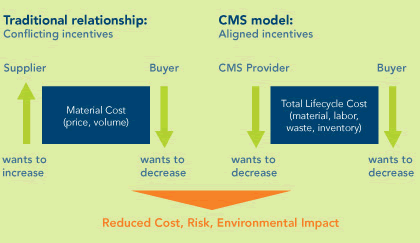
By aligning the incentives of suppliers and customers, both can achieve bottom line benefits via reduced chemical use, costs, and waste. Fewer chemicals in the overall equation can also result in significant environmental benefits (which, of course, takes us back to the less-quantifiable benefits of reduced liabilities). This is a major shift with major implications, and yet, the model is compatible with many emerging business management trends. It highlights strengthening a company's core business, outsourcing support functions, and building strategic alliances with suppliers.
Chemical services encompass a range of chemical management activities that are contracted to a chemical service provider, or Tier 1 supplier. A chemical service provider may be a chemical supplier, waste hauler, or environmental engineering firm that offers a range of services to manage a company's chemicals. They may purchase and deliver chemicals, maintain the inventory, and track MSDS's, implement process efficiency improvement, collect data for environmental monitoring and reporting, and manage waste collection and disposal operations.
When people think about their chemical management system, they may consider a narrow or broad range of activity.
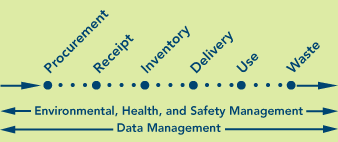
We use the term "chemical lifecycle" as a framework to characterize the chemical management system and the costs associated with it (see Figure 2). By pulling the chemical costs out at each step of the lifecycle, you can identify the hidden costs associated with chemical use. The true costs of chemicals can be obscured because they are distributed among many departments within a company. In addition, departments are often required to pay an "overhead" expense, which can include chemical costs associated with energy, waste removal, storage, training, etc.
Figure 2: Chemical Lifecycle
Any chemical service program has two dimensions: the Chemical Lifecycle and the Chemical Range.
Chemical Lifecycle. The chemical lifecycle refers to the scope of services that a chemical service provider performs. Services may include purchasing chemicals, maintaining inventory, providing "just-in-time" delivery, managing chemicals onsite, maintaining MSDSs (Material Safety Data Sheets), tracking chemical use, and identifying and implementing efficiency improvements.
Chemical Range. The chemical range is the sum total of all the chemicals managed by a service provider. For example, some companies contract a service provider to manage only their coolants, whereas other companies will contract for all their chemicals including maintenance chemicals .
Why Change Your Chemical Management System?
In working and talking with several companies, CSP has seen the cost of chemical
management range from $1.00 to $3.00 for every dollar of chemical purchased.
That means for a facility purchasing $5 million in chemicals, they are spending
an additional $5 million to $15 million managing those chemicals. These high costs
are due to the concealed expenses behind chemical use, like compliance, safety,
disposal, and floor space.
For most manufacturing companies, chemical management is not considered part of the "core" business. Chemicals are a very important part of manufacturing, but managing them is not generally a process that attracts much management attention - until something goes wrong. As a result, chemical management often does not run as efficiently and cost effectively as other manufacturing processes.
Getting your chemical management system in order has benefits on many levels. Aside from lowering costs, some primary reasons companies launch a strong effort to improve their chemical management include:
- Reducing liability
- Leveraging the expertise of a supplier
- Freeing up floor space for manufacturing
- Reducing chemical use to drop emissions below environmental reporting thresholds
- Reducing the number of accidents on site
- Improving staff productivity by eliminating chemical management tasks from their overall responsibilities
- Increasing employee safety
Why Does it Work? How Far Can it Go?
As outlined above, the chemical service model delivers results by aligning
the incentives of chemical suppliers and their customers. The supplier's
profitability is independent of the volume of chemicals sold. In other
words, the suppliers no longer get paid based on how well they can sell,
but how well they can manage. This is accomplished by establishing supplier
compensation on performance-based metrics and fees. This is what makes
chemical service a "service-based" model.
Generally, chemical service providers begin by offering a narrow range of chemical management services. That is, they don't start out in client companies by taking over management of all chemical needs. For example, a chemical service provider might purchase and deliver chemicals, manage MSDSs, pick up waste, and provide data for some environmental reports. Later, they might expand their work scope to include such services as research for chemical substitutes and process efficiency improvements (see Figure 3 below).
Figure 3: Potential Scope of Services
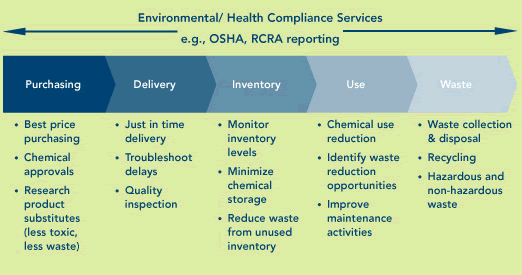
In the most advanced stage, the chemical service provider would be compensated per each unit of quality product successfully produced (e.g., a fixed fee per100 toaster ovens produced, or 1000 circuit boards cleaned).
These chemical services are often performed more effectively and at a lower cost than companies can do by themselves.
Chemicals become an operational cost to the supplier instead
of the manufacturer. As with labor, utilities, and other material inputs, the supplier
now has an incentive to use fewer chemicals
to yield higher margins. The manufacturer
gains a partner in its efforts to manage chemicals more efficiently; the supplier
becomes an integral part of the business by providing a differentiated, value-added service.
Successful Examples
Several companies within the automotive, electronics, aerospace/airline, and
metalworking industries have adopted CMS relationships with their suppliers.
These restructured contracts between chemical suppliers and their customers
have yielded reduced costs, improved quality, and streamlined chemical handling.
Several successful examples are outlined below:
| Industry/Company | Benefits |
Delta Airlines |
|
| Raytheon Company (Aerospace) |
|
| General Motors (Automotive) |
Benefits from single CMS contract over 6 years:
|
(For information about specific CMS programs, go to Case Studies.)
These companies now enjoy tangible benefits such as reduced costs, improved product quality, and streamlined chemical handling. And, at the risk of sounding redundant, we can't forget to mention the "uncountables" like improved workplace safety, better reputation assurance, etc. Whether accounted for or not, they all contribute to competitive advantage in the marketplace.
Barriers to Adopting CMS
Even with these tremendous incentives, companies have difficulty initiating a CMS program. It is an investment of
time and resources to develop a chemical service program, but in
the majority of cases, the benefits significantly outweigh the costs.
In our work with pilot companies, CSP has found that many of the same barriers exist for most companies interested in initiating a CMS program. The following table outlines some of the key barriers, and CSP's responses and suggestions for overcoming them.
|
Key Barriers & CSP Responses Or...Why Aren't More Companies Doing It? |
|
| Barriers | CSP Responses |
| A common perception is that chemicals are a small percentage of overall operating costs. | Once a company conducts a total chemical lifecycle cost accounting baseline, the true costs of chemical management become transparent. CSP's Manual, Tools for Optimizing Chemical Management, can assist companies in this effort. |
| Transition to be a comprehensive CMS program can be complicated, and a common perception is that overall transition costs are high. | A well planned approach and workplan results in lower transition costs and minimal complications. |
| Lack of strong management support can result in failure to get a CMS program off the ground. | Support at all levels is imperative to reduce the institutional inertia that can otherwise derail any initiative. |
| Lack of understanding and knowledge about supplier capabilities
prevents many companies from finding out what is possible. |
CSP has been working to build customer/supplier relationships and to document supplier capabilities. This is being facilitated through the CSP membership. |
| Adoption of CMS has been hindered by a lack of credible,
3rd party information on opportunities and benefits.
|
CSP has led the effort to document and disseminate credible information through case studies, workshops, articles, etc. |
Where Do I Start?
CSP has worked with many companies to help them initiate a CMS program. Go
to Getting Started
or call CSP at (415) 421-3405 to find out more about the CSP approach and
specifics for what you can do to start a CMS program at your facility.
Copyright 2007 Chemical Strategies Partnership, All Rights Reserved